

From: [email protected]Date: Tue, 30 Mar 2010 15:37:50 -0700 (PDT)
Inertia is not really explained by the Arabic translation: qosoor zaati (قصور ذاتى) because I like the word "To2l w Dalal" (تقل و دلال) much more. Now seriously, i think somebody arabized the word from Newton's book rather than draw on the rich Arabic scientific literature during the medievals, still To2l w Dalal is a better translation in my opinion as you'll come to see.
Inertia is actually an important part of Newton's work of classical mechanics. It won't help understand much still but for those who like to collect relics, here it is as quoted from Wikipedia:
"The vis insita, or innate force (yo2sod "elTo2l wel Dalal" or Inertia) of matter is a power of resisting, by which every body, as much as in it lies, endeavors to preserve in its present state, whether it be of rest, or of moving uniformly forward in a straight line."
Isaac Asimov who is a late academic in Bio-chemistry and one who wrote my favourite Sci-Fi triology called "The Foundation", has made some of the best explanations I've seen in English: "This tendency for motion (or for rest) to maintain itself steadily unless made to do otherwise by some interfering force can be viewed as a kind of 'laziness', a kind of unwillingness to make a change."
Now let's see how can we use the word in our talk. If you push something and it starts to move slowly and keep increasing its speed ever so slowly, then this car has LARGE inertia. If you push it and it moves quickly and accelerates fast, this is a body with a SMALL inertia. Generally, it's directly proportional with your weight (scientifically tweaked to what they call 'Mass' so that they won't keep changing the numbers every time they land on a different planet with different gravity).
So if you have large amount of To2l w Dalal, people will find it difficult to move you off your track, so to say.
In desert practice, it's easy to guess that heavy 4x4s (Land Cruisers, for instance) can have plenty of Gharz in soft sand. So 4x4ers use their heads and their engines and have some speed.
With relatively moderate speed (you should never venture into high speed in desert situations unless with assistance team watching your experiments with helicopters like in Rally), one can have small cars quickly stopped by soft sands while 4x4s with high To2l w Dalal (I mean inertia) are hard to stop.
If you wish, there's a little extension to that called Momentum. To explain it, you have to remember first that Mike Tyson's punch can be equal in damage to your ribs like this of car hitting you in the chest.
The car has much more inertia than Tyson's fist, but Tyson's is much faster. So light bodies with large speed could be difficult to stop (=Momentum) as much as a large body with small speed.
Hope that didn't confuse you even more. :)
Salaam,
Mohamed Mabrouk
-------
I might sound like a crazy dreamer but.. only crazy dreamers can come up with ideas like the Egyptian pyramids!
-------
________________________________
From: Mohamed Mabrouk
To: [email protected]
Sent: Mon, March 29, 2010 7:00:26 PM
Subject: Re: [SaharaSafaris] physical factors affecting car / road handling
Dear Rasha and All,
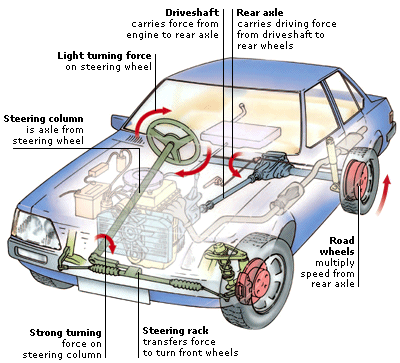
Here's another interesting sketch to tell you names of important parts.
Axle: (Arabic: Ax)
Driveshaft: (Arabic: kerdaan)
-------
I might sound like a crazy dreamer but.. only crazy dreamers can come up with ideas like the Egyptian pyramids!
-------
________________________________
From: Mohamed Mabrouk
To: [email protected]
Sent: Mon, March 29, 2010 6:52:36 PM
Subject: Re: [SaharaSafaris] physical factors affecting car / road handling
Dear Rasha,
This is not exactly mechanics, but physics which is too theoretical for some. This part I maybe able to help with.
If you understand it, you maybe be able to think of new enhancements in your next 4x4 ;)
Now, Traction, kinetic friction are needed to understand how the car moves using its wheels.
when you look at wheels, you'll find them connected with rods called Axles.
Those axles are rotated by the power of the engine to rotate the wheels which in turn push the ground underneath backward . We all know from experience that this of course, pushes the car forward.
Now to "slip" the wheels is to waste all the power of the engine and no movement of the car could happen so we do EVERYTHING to prevent slippage which means to keep "traction" between the tire and ground. Traction here doesn't mean that tire sticks to the ground but whichever face it has on the ground it acts as if sticking and never slip.
This converts all the engine power to movement (aka kinetic energy).
There are many ways to keep traction. Please note that when we have Gharz situation in the sand, that this is usually not because car is week but because it has lost traction and one or more wheels are rolling totally freely taking all the engine power with them to waste in the air.
Any questions so far? :)
Salaam
Mohamed Mabrouk
-------
I might sound like a crazy dreamer but.. only crazy dreamers can come up with ideas like the Egyptian pyramids!
-------
________________________________
From: Rasha Aboul Enein ( Leases Coordinator PMHQ )
To: "[email protected]"
Sent: Mon, March 29, 2010 8:13:43 AM
Subject: [SaharaSafaris] physical factors affecting car / road handling
Dear SS,
I need your help to
understand some physical factors affecting car / road handling. The factors
are:-
Traction,
friction,
kinetic friction/energy,
inertia,
hydroplaning,
centrifugal force,
gravity and center of
gravity.
I read about them but
need to have someone explain them to me in a better way. By that I mean really
simple way.
I would really appreciate
your help.
Thanks;
Rasha Aboulenein
Inertia is actually an important part of Newton's work of classical mechanics. It won't help understand much still but for those who like to collect relics, here it is as quoted from Wikipedia:
"The vis insita, or innate force (yo2sod "elTo2l wel Dalal" or Inertia) of matter is a power of resisting, by which every body, as much as in
it lies, endeavors to preserve in its present state, whether it be of rest, or of moving uniformly forward in a straight line."
Isaac Asimov who is a late academic in Bio-chemistry and one who wrote my favourite Sci-Fi triology "The Foundation", has made some of the best explanations I've seen in English for what Inertia is about: "[inertia is] this tendency for motion (or for rest) to maintain itself steadily unless made to do otherwise by some interfering force can be viewed as a kind of 'laziness', a kind of unwillingness to make a change."
Now let's see how can we use the word in our talk. If you push something and it starts to move slowly and keep increasing its speed ever so slowly, then this car has LARGE inertia. It means it is difficult to start moving and difficult to stop (waad te2eel mesh ay 7aga twadih w tgiboh). If you push it and it moves quickly and accelerates fast, this is a body with a SMALL inertia (ya3ni waad khafif, ay 7aga twadih w tgiboh).
Generally, it's directly proportional with your weight (scientifically tweaked to what they call 'Mass' so that they won't keep changing the numbers every time
they land on a different planet with different gravity).
So if you have large amount of To2l w Dalal, people will find it difficult to move you off your track, so to say.
In desert practice, it's easy to guess that heavy 4x4s (Land Cruisers, for instance) can have plenty of Gharz in soft sand. So 4x4ers use their heads and their engines and have some speed.
With relatively moderate speed (you should never venture into high speed in desert situations unless with assistance team watching your experiments with helicopters like in Rally), one can have small cars quickly stopped by soft sands while 4x4s with high To2l w Dalal (I mean inertia) are hard to stop.
If you wish, there's a little extension to that called Momentum. To explain it, you have to remember first that Mike Tyson's punch can be equal in damage to your ribs like this of car hitting you in the chest.
The car has much more inertia than Tyson's fist, but
Tyson's is much faster. So light bodies with large speed could be difficult to stop (=Momentum) as much as a large body with small speed.
Hope that didn't confuse you even more. :)
Salaam,
Mohamed Mabrouk
-------
I might sound like a crazy dreamer but.. only crazy dreamers can come up with ideas like the Egyptian pyramids!
-------
From: Mohamed Mabrouk <[email protected]>
To: [email protected]
Sent: Mon, March 29, 2010 7:00:26 PM
style="font-weight: bold;">Subject: Re: [SaharaSafaris] physical factors affecting car / road handling
-------
I might sound like a crazy dreamer but.. only crazy dreamers can come up with ideas like the Egyptian pyramids!
-------
From: Mohamed Mabrouk <[email protected]>
To: [email protected]
Sent: Mon, March 29, 2010 6:52:36 PM
Subject: Re: [SaharaSafaris] physical factors affecting car / road handling

all know from experience that this of course, pushes the car forward.

so far? :)
-------
I might sound like a crazy dreamer but.. only crazy dreamers can come up with ideas like the Egyptian pyramids!
-------
From: Rasha Aboul Enein ( Leases Coordinator PMHQ ) <[email protected]>
To: "[email protected]" <[email protected]>
Sent: Mon, March 29, 2010 8:13:43 AM
Subject: [SaharaSafaris] physical factors affecting car /
road
handling
Dear SS,
I need your help to
understand some physical factors affecting car / road handling. The factors
are:-
Traction,
friction,
kinetic friction/energy,
inertia,
hydroplaning,
centrifugal force,
gravity and center of
gravity.
I read about them but
need to have someone explain them to me in a better way. By that I mean really
simple way.
I would really appreciate
your help.
Thanks;
Rasha Aboulenein